
Personal Knowledge Base
Feed it URLs and PDFs and it indexes them locally with vector embeddings; ask questions and it answers from the indexed material with cited sources. Everything runs on your machine — embeddings, vector search, the database itself — only the answer synthesis call goes to Anthropic.
Setup
1. Download Friday
- Go to hellofriday.ai and download the macOS installer
- Open the DMG and drag Friday to your Applications folder
- Launch Friday and complete the initial setup
2. Import the workspace
- Open Friday and go to Discover Spaces
- Find Personal Knowledge Base and click it
- Click Add Space
3. First-run dependencies
The two Python agents bring their own dependencies via pyproject.toml. The first time you trigger ingestion or a query, Friday runs uv to:
- Provision a Python 3.12 interpreter under
~/.friday/local/uv/python/ - Install
sentence-transformers,sqlite-vec, andpymupdfinto a cached environment - Download the
BAAI/bge-large-en-v1.5embedding model (~1.3 GB) from HuggingFace into~/.cache/huggingface/
This is one-time per host and takes a couple of minutes. Subsequent runs are fast. No manual pip or venv step.
The model download is ~1.3 GB. On a slow or flaky connection it can stall. If it does, set
HF_HUB_DISABLE_XET=1in Friday's environment and retrigger — it switches HuggingFace to the plain HTTP downloader, which is more resilient to interrupted transfers.
4. Make sure Python can load SQLite extensions
sqlite-vec is a loadable SQLite extension, so the agents need a Python whose sqlite3 module was compiled with extension support. The default macOS system Python and the python.org 3.12 build ship without it, and uv run --python 3.12 may select one of those. When that happens, the agents fail immediately with a clear error:
This Python lacks SQLite loadable-extension support, which sqlite-vec requires…
The fix is one command — install a uv-managed CPython, which has extension support enabled:
uv python install 3.12
Then retrigger the workspace. requires-python = ">=3.12" in each agent's pyproject.toml only gates the version, not the build flag, so this can't be caught at install time — the preflight guard catches it at runtime instead.
5. That's it
No API keys to configure beyond Anthropic (already set during Friday setup). No external services. The vector DB lives at ~/.friday/local/workspaces/personal-knowledge-base/kb.db.
How it works
| Component | Role |
|---|---|
ingest-url / ingest-pdf / query-kb signals |
HTTP triggers at the matching paths |
ingest-url job |
Two-state FSM: idle → ingest |
ingest-pdf job |
Two-state FSM: idle → ingest |
query-kb job |
Two-state FSM: idle → answer |
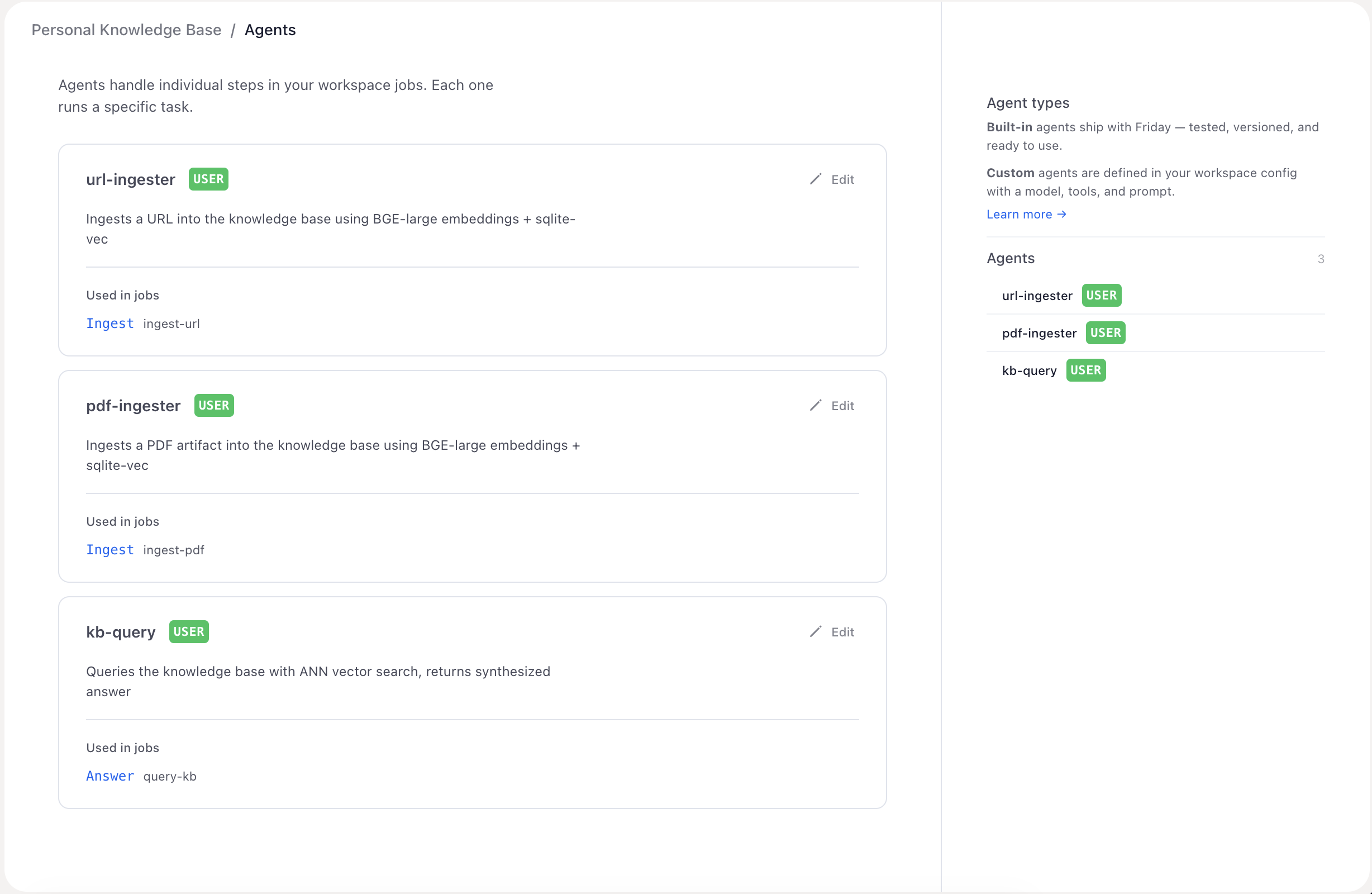
url-ingester, pdf-ingester |
Both point at the kb-ingest-agent Python agent — same code, different signal payloads |
kb-query |
Points at the kb-query-agent Python agent |
kb-ingest-agent |
Python user agent: chunks content, embeds with BGE, writes to SQLite + sqlite-vec. Uses pymupdf for PDF text extraction. |
kb-query-agent |
Python user agent: embeds the question, runs ANN search via sqlite-vec MATCH query, hands the top 10 chunks to Claude Sonnet for synthesis. |
knowledge-base long-term memory |
Narrative log of every successful ingestion (source, title, doc_id, chunk count) — useful for "what have I ingested?" queries via chat. |
The DB schema is three tables: documents (one row per ingested source), chunk_metadata (chunk text + foreign key), and chunk_embeddings (a vec0 virtual table holding 1024-dim float vectors). The kb-query-agent joins the vector match against chunk_metadata and documents to surface source titles in the synthesized answer.
